
Why collectors value cobalt blue glass

Cobalt in glass since Egypt’s 18th Dynasty, 1550–1292 BC

Why do collectors value cobalt blue glass? Put a cobalt vase in the morning sun, and its colour lands on the wall behind it. Part of the answer is in that colour. The rest is in what this blue has been for more than three thousand years: a stand-in for lapis lazuli, a warning, the name of a city, a colour that sold.
01. A little cobalt, a deep blue
Cobalt is one of the strongest colourants glass has. About 0.05 per cent of cobalt oxide is enough for a rich, deep blue. Copper, which gives glass its blues and greens, needs one to two per cent. Glassmakers’ figures are small: five ounces of cobalt to a ton of glass for blue, up to ten pounds for the deepest shades.
The same strength makes cobalt glass a tool. In a flame test, a plate of it hides the yellow light of sodium, so that the other colours of the flame can be seen.

02. Thin and thick, light and dark
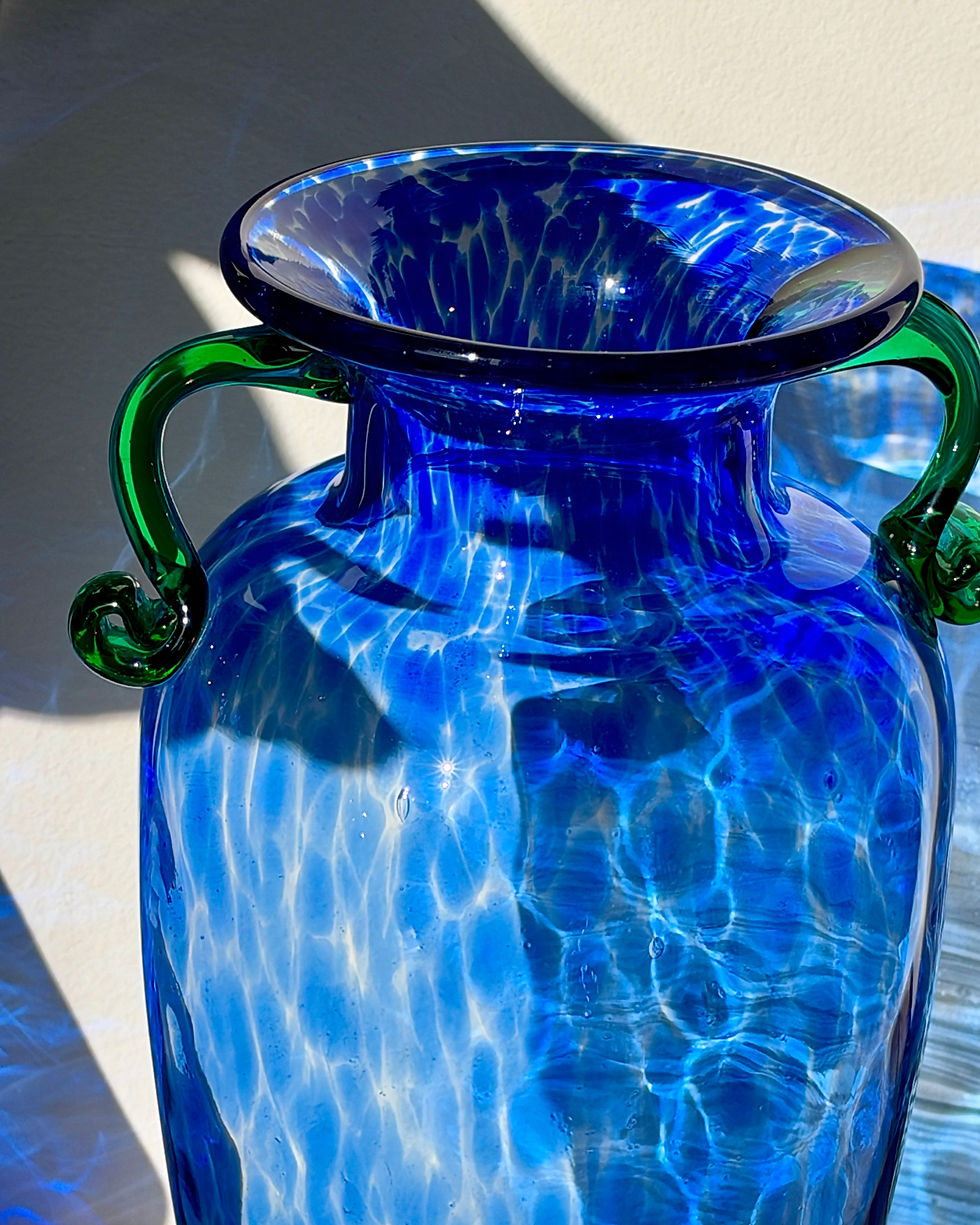
A cobalt piece is never one blue. Where the glass is thin, at the flared rim of the vase in
these photographs, the blue is bright and clear. In the full lower body it deepens, and the very edge of the rim is almost black. Bottle researchers have a name for the darkest shade, midnight blue: cobalt so dark that without strong light behind it, it looks black. With the sun behind it, the same glass casts its colour across the room.
03. A blue for lapis lazuli
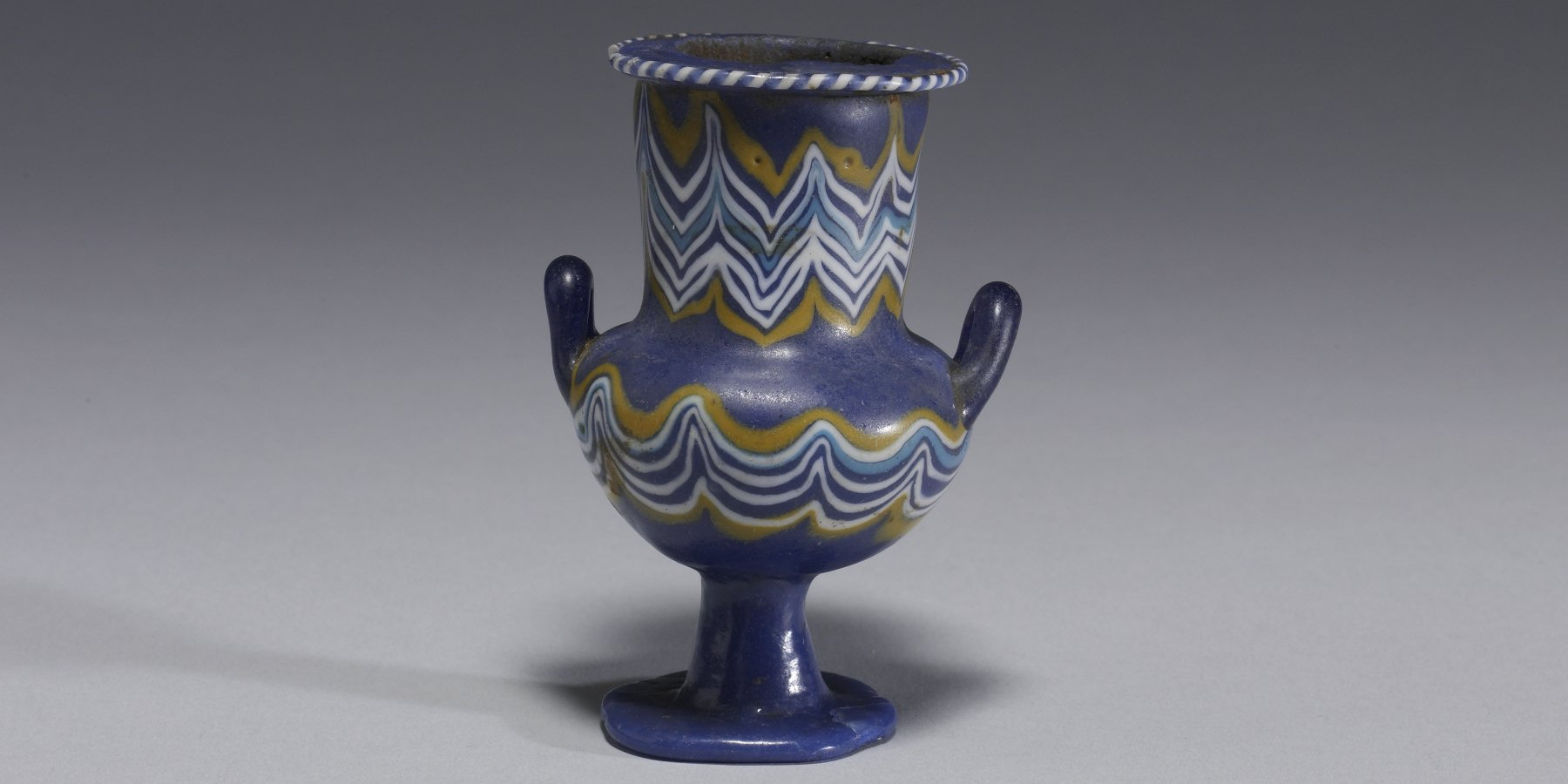
The oldest cobalt-coloured glass comes from Egypt’s 18th Dynasty. It was made mostly at Malqata and Amarna, in mid to dark blues, to imitate lapis lazuli. Much of the earliest glass was made for luxury: coloured glass vessels held perfumes and cosmetics. On a wall of the temple at Karnak, the annals of Thutmose III show the spoils of his campaigns - gold, silver and glass, among it three baskets of something dark blue, perhaps glass ingots. Silica and fluxes were easy to come by, and a study of 2019 suggests that the colourant may have been worth more than the glass. Around 1250 BC cobalt, and glass with it, almost disappears from the record.
04. A goblin’s name
For a long time the blue was put down to bismuth. Miners called some of the ores behind it kobold ore - goblin ore, in German - because they gave little of the metals they knew, and poisonous arsenic fumes when smelted. Around 1735 the Swedish chemist Georg Brandt showed that the colour came from a metal of its own. It took the goblin’s name: cobalt. Ground to powder, cobalt glass became smalt, a colourant for glass and enamel.
05. Bristol blue
In eighteenth-century England the blue took the name of a city. According to a 1990 article, William Cookworthy, looking for cobalt for the blue on his white porcelain, obtained the exclusive right to import cobalt oxide from the Royal Saxon Cobalt Works. The best-known makers of Bristol blue glass in the 1780s were Lazarus Jacobs and his son Isaac, and Isaac made Bristol blue a name known across the country. A bowl of blue glass of about 1805 in the Victoria and Albert Museum is signed in gilt: “I Jacobs Bristol”. Production stopped around 1923; an exhibition in Bristol in 1988 began its revival.

06. Blue as a warning
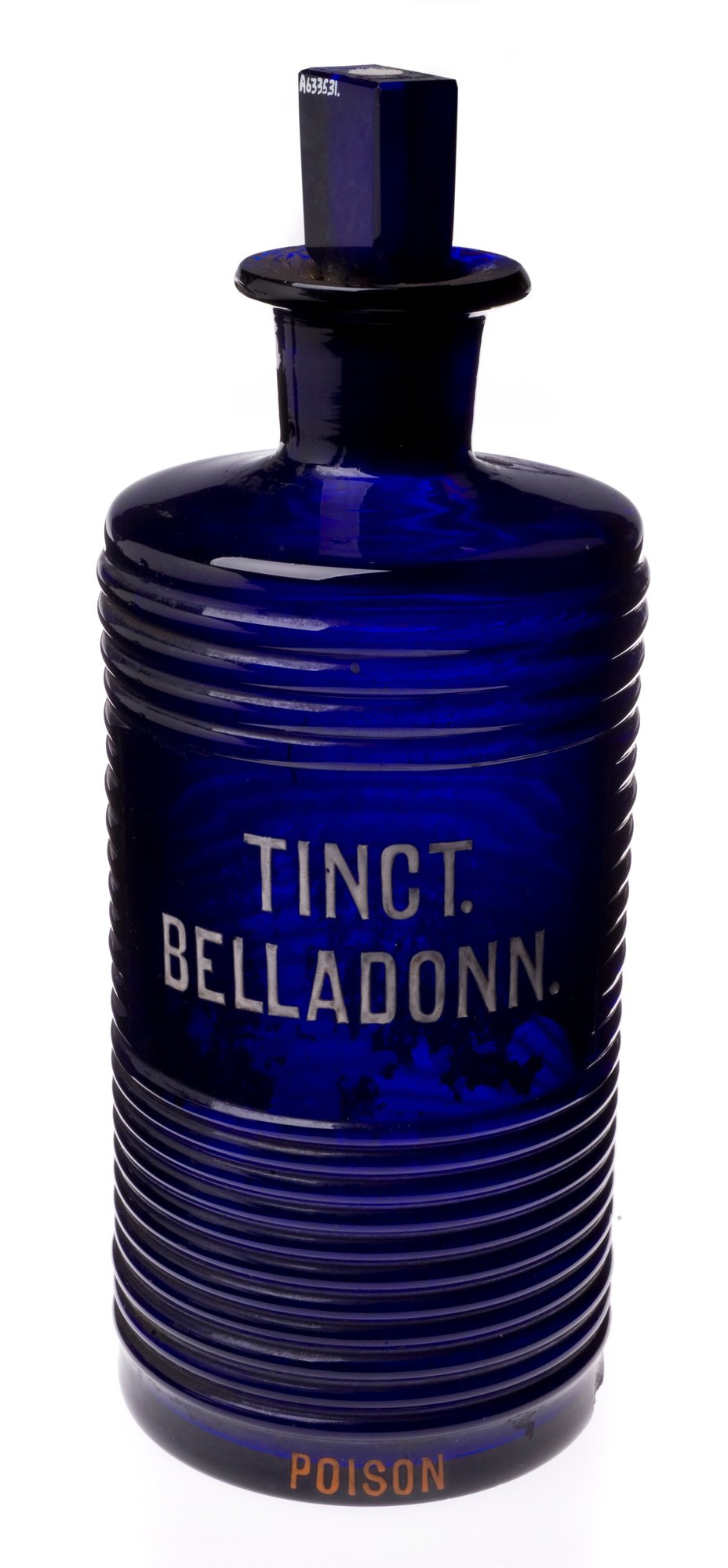
Cobalt also had work to do. In its catalogue of 1880 the glassworks Whitall, Tatum & Co. offered poison bottles “of a deep cobalt blue color”, their surface covered with sharp diamond-shaped points, to prevent mistakes night and day - “by the touch, as well as by sight”. Most poison bottles of the time carried such warnings: bumps and ridges, bright colours, unusual shapes.
07. The colour that sold
A collectors’ reference puts it plainly: cobalt blue is one of the most popular colours in glass. The glassmaker Frank M. Fenton observed that blue glass sold more quickly, and for a better price, than any other colour.
Depression glass, the inexpensive machine-pressed American glassware of about 1920–1950, shows it in figures. In the 1930s Hazel-Atlas made a cobalt breakfast set with a likeness of Shirley Temple for General Mills. The story goes that when the promotion ended, the factory was left with vats of blue glass and used it for its Royal Lace pattern. Sold as Ritz Blue, it did so well that less and less green and pink was made. In 2008 the National Depression Glass Association put a five-piece place setting of Royal Lace at 165–185 dollars in blue, 85–110 in pink or green, and 40 in clear glass.
Popularity has another side. The Shirley Temple pieces and several other cobalt Depression patterns have been reproduced. In Royal Lace, an old tumbler has the pattern on its base; a reproduction does not.
08. The vase in these photographs
The vase-goblet here is attributed to Empoli, in Tuscany, b
ut no label confirms it. It is 27.7 centimetres tall. The ribs of its neck show on the inside too, a sign of glass blown into a mould; the lower body carries a pattern of small diamonds. The stem and the foot are clear glass, the rim is scalloped. Auction houses list similar pieces - patterned glass on a clear stem or foot - as Empoli, mostly of about 1960–1970, and often with a hedge: “attributed”, “Empoli-style”.
Collectors give their reasons: so deep a colour from so little, more than three thousand years of history, a market that has paid more for blue. One more needs only the sun. Look at the wall behind the glass.
Sources: J. R. Wood and Y.-T. Hsu, “An Archaeometallurgical Explanation for the Disappearance of Egyptian and Near Eastern Cobalt-Blue Glass at the end of the Late Bronze Age”, Internet Archaeology 52, 2019; A. Hodgkinson and D. A. Frick, data set of Co-coloured Egyptian glass from Amarna, GFZ Data Services; Walters Art Museum; Corning Museum of Glass, Glass Dictionary - smalt, Depression glass; Victoria and Albert Museum, C.49-1936; Society for Historical Archaeology, Bill Lindsey, Historic Glass Bottle Identification - “Medicinal/Chemical/Druggist Bottles”, “Bottle & Glass Colors”; National Depression Glass Association, Rosemary Trietsch, “Hazel Atlas’ Royal Lace”, 2008; Angela M. Bowey, Glass Encyclopedia, “Cobalt Blue Glass”; Leslie Hindman, 2002; Wellcome Collection; Wikipedia - Cobalt, Cobalt glass, Georg Brandt, Bristol blue glass; auction listings of Empoli glass on the-saleroom.com.
Comments